
“Liberté, égalité, fraternité” - French History in Pamphlet Form
By Zara Strauss, Digital Collections and Preservation
In addition to the many fascinating histories of local Delawareans, the University of Delaware’s Special Collections maintains a focus on collecting interesting and unique historical collections that document European history since the 16th century. Two collections encapsulate this interest well: The Frank W. Tober collection of French Revolutionary-era song sheets and pamphlets and the French Revolutionary Era Pamphlets.
The Tober French Revolution pamphlets and song sheets represent a unique portion of a larger collection brought to the University of Delaware’s Library by Frank Tober. Frank W. Tober was a chemist with the Du Pont Company and collected a wide range of material, many of which are now under the care of the University’s Special Collections. This specific collection has song sheets and pamphlets relating to the political situation in France during the revolutionary period.
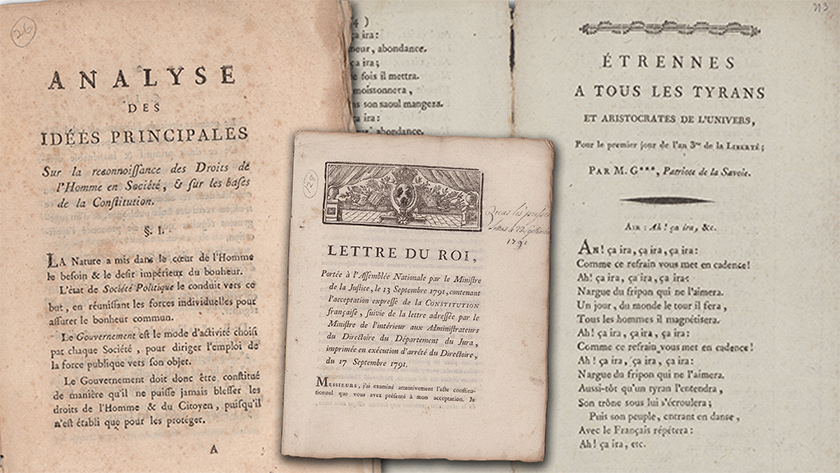
One interesting song sheet out of this collection is a unique take on “Ça ira,” French for “it’ll be fine,” and the name of an emblematic song of the French Revolution. While it features different lyrics, its call for revolution is the same.
![Étrennes à tous les tyrans et aristocrates de l'univers, pour le 1er jour de l'an 3me de la liberté. [The first in the firing line of all the tyrants and aristocrats in the universe, for the first day of the third year of liberty.] Box: 1, Folder: 1. MSS 0473.](https://library.udel.edu/news/wp-content/uploads/sites/33/2026/03/April2026_CuratedCollection_IMG1_Wordpress-Flex-Image-324x213-1.jpg)
Étrennes à tous les tyrans et aristocrates de l’univers, pour le 1er jour de l’an 3me de la liberté. [The first in the firing line of all the tyrants and aristocrats in the universe, for the first day of the third year of liberty.] Box: 1, Folder: 1. MSS 0473.
A rough translation is as follows:
“How this refrain sets your pace!
Ah! It will be fine, it will be fine, it will be fine:
Mock the scoundrel who does not love it.
One day, it will travel the world, magnetizing all men.
Mock the scoundrel who does not love it.
As soon as a tyrant hears it,
his throne will crumble beneath him;
and then his people, dancing,
will repeat with the French:
Ah! It will be fine, etc!”
Similar to the Tober collection, the French Revolutionary Pamphlets collection represents this tumultuous time in French history. This collection is a vivid inside look into the triumphs, struggles and everyday life of people living through turbulent times of great political change.
The pamphlets document significant periods, events and administrations in French history such as the meetings of the National Assembly (1789), the reform decrees of Louis XVI (1789-91), the Constituent Assembly laws (1790-92), the Thermidorian Reaction (1794-95) and even briefly, Napoleon (1795-1818).
Any French history buff will recognize some of the names attributed to these pamphlets regardless of their French language skills, such as King Louis XVI himself, with many of his declarations and royal decrees relating to the government being featured.
For example, Louis XVI’s declaration that he has accepted the National Constituent Assembly’s constitution:
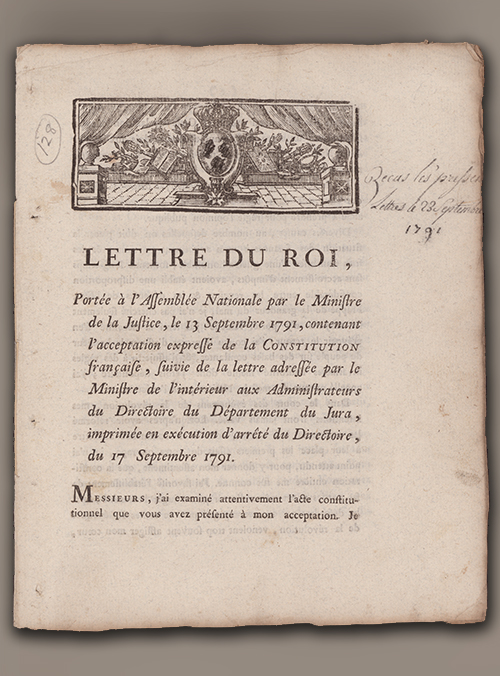
Louis XVI. Lettre du Roi, portée à l’Assemblée nationale par le ministre de la justice, le 13 septembre 1791, contenant l’acceptation expresse de la Constitution française, Suivie de la Lettre adressée par le ministre de l’Intérieur aux administrateurs du directoire du Département du Jura, imprimée en exécution d’arrêté du Directoire, du 17 Septembre 1791. Lon-le-Saunier: Imprimerie de Claude-André Delhorme, 1791. Box: 3, folder: 128. MSS 0999.
While it gives off sincerity and a sense that he was pleased to accept the constitution, Louis XVI was more or less forced to sign this, and did so only after he was made to return to Paris after attempting to escape civil unrest with his wife, Marie Antoinette, and their children only a few months prior. This event sparked further public outrage and was even expected by some. By accepting this constitution, Louis XVI was allowed to remain king, but at the cost of a majority of his powers as a monarch.
Another interesting pamphlet is one that helps set the stage for revolution. This pamphlet analyzes the ideal principles regarding the rights of man in society and how the constitution is meant to protect their rights.
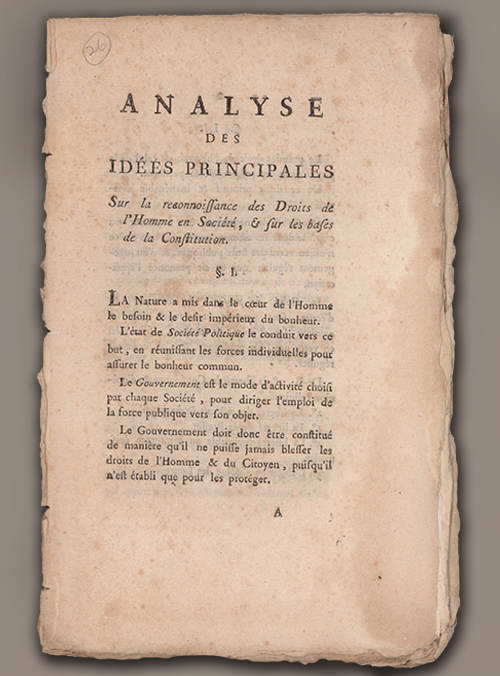
Thouret, Jacques-Guillaume. Analyse des idées principales sur la reconnaissance des droits de l’homme en société, & sur les bases de la Constitution. Édité par M. Thouret. Paris ; Versailles: Chez Baudouin, imprimeur de l’Assemblée Nationale, 1789. Box: 1, Folder: 26. MSS 0999.
Published in 1789 and written by National Constituent Assembly member Jacques-Guillaume Thouret, it gives us an idea of what the concerns of the people of France were at the time. It reflects the intentions of the Assembly, as well as the popularity of their “Declaration of the Rights of Man and of the Citizen” which laid out essential human and civil rights. French people who had long been oppressed under the absolute monarchy, or the Ancien Régime, were able to see exactly what basic rights they were owed and think about precisely what they were missing under the King. The relationship between subject and monarch was one without equal give and take, but the ideas highlighted in this pamphlet portrayed a way of life where a citizen provides for the state in return the state provides for its citizens.
With over a thousand pamphlets to scan and upload into the University of Delaware’s Digital Collections in AM Quartex, more is to be uncovered about this exciting time in French history.