
A View from the Vault: Uncovering the History of a Brazilian Amethyst Geode
by Sharon Fitzgerald, curator, Mineralogical Museum
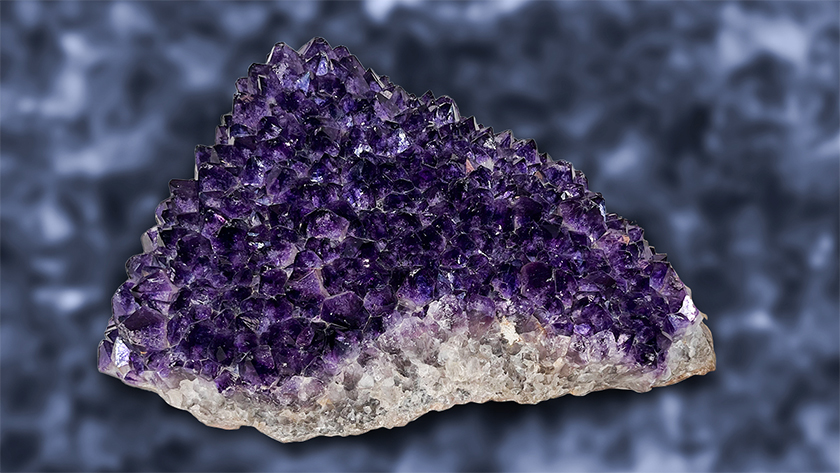
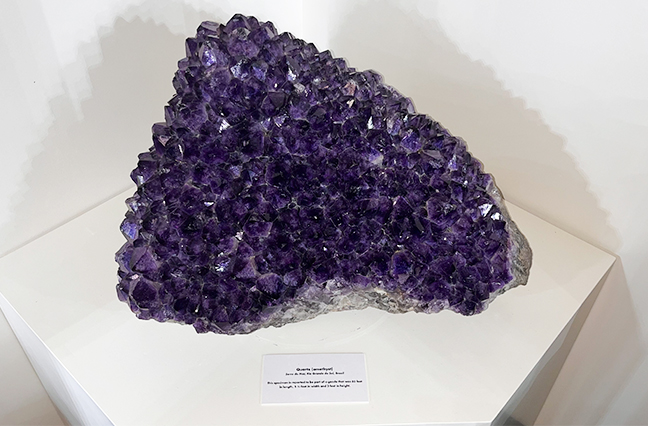
A striking mineral specimen has recently been put on view in the University of Delaware’s Mineralogical Museum. The 227-pound amethyst quartz specimen, previously on loan to the Delaware Geological Survey, now has a new home on a specially constructed pedestal that allows visitors to appreciate its remarkable size, color and crystalline structure.
The specimen was part of the Irénée du Pont mineral collection, a significant gift to the University in 1970. Its catalog card (64/2458) notes that it originated from Serra do Mar, Rio Grande do Sul, Brazil, and documents its weight. But the story behind the deep-purple crystals reaches well beyond UD.
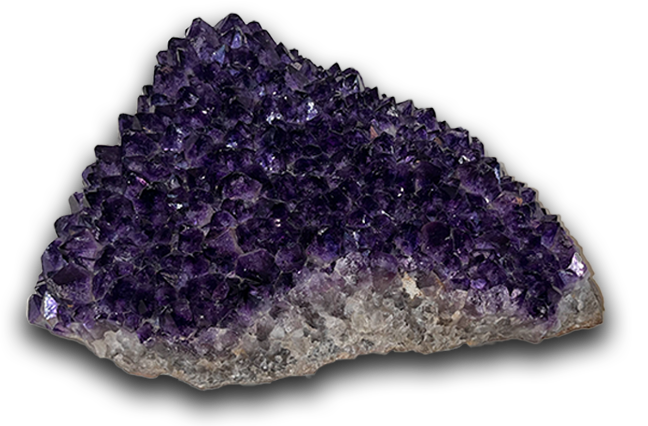
The specimen has long been believed to be a portion of a much larger amethyst geode, with other pieces held in museums around the world. Verifying the history proved more complicated than expected. Early accounts suggested that the original geode was a massive 35-ton formation, measuring approximately 32 feet long. Although this extraordinary size seems unbelievable, it appeared in several contemporary accounts. Due to the huge size and the difficulty of transporting the geode, it was split into multiple pieces, with portions exhibited in Europe in the early 1900s.
Specimens from the geode appear in the collections of various institutions in the U.S. and abroad. The Smithsonian holds a similar specimen identified as part of a 70,000-pound (35-ton) geode. Like the specimen at the University of Delaware, it is distinguished by the presence of large, deep-purple crystals. According to Paul Pohwat, curator at the Smithsonian, its specimen was acquired in 1904 from Henry Ward, founder of Ward’s Natural History Establishment, for $300. It was purchased for exhibition at the 1904 Louisiana Purchase Exposition.
The University of Delaware’s specimen came from a different source. Records show that Irénée du Pont purchased it from Tiffany & Co. in 1919 as part of a large mineral collection he had encountered at the company’s New York store. Tiffany’s shipping paperwork documents the number of boxes transported and notes that several of the larger minerals required crating and shipment by rail.
One of the most detailed descriptions of the original formation appears in Dana’s System of Mineralogy, written by Harvard University mineralogist and professor Clifford Frondel in 1962. Frondel described a remarkable cavity at Serra do Mar, Brazil, measuring 33 feet long, 5 1⁄2 feet wide and 3 feet high, lined with brilliant, deep-violet amethyst crystals averaging approximately 4 centimeters across. He also noted that large specimens from the occurrence are preserved in museums around the world.
Although some details of the original geode’s history remain unverified, the records establish an intriguing connection between a remarkable Brazilian mineral formation, the University of Delaware and museums beyond Delaware. Today, visitors can see UD’s 227-pound piece of that history up close in the Mineralogical Museum.
“A View from the Vault” showcases some of the unique, notable or rare items that are a part of the Special Collections and Museums holdings at the University of Delaware. Each month, we highlight a different work and share interesting facts or intriguing histories about it. If you are interested in seeing any of the materials featured in person or want to learn more about any work showcased in the series, please contact Special Collections and Museums at AskSpec or AskMuseums.