
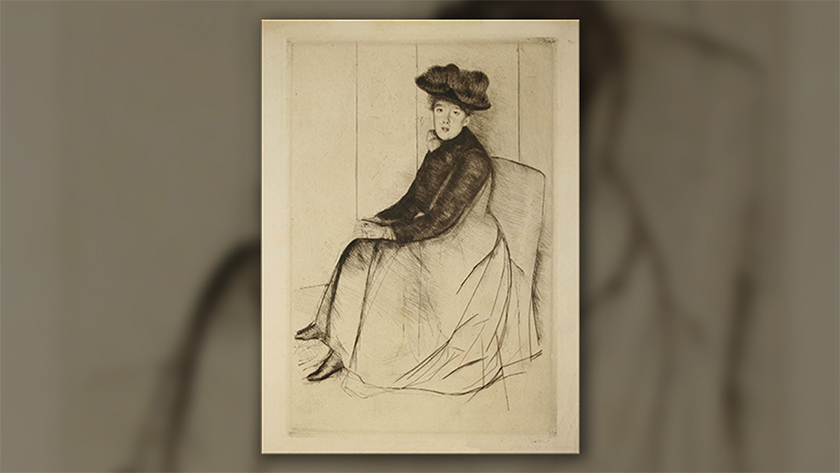
Mary Stevenson Cassatt (United States, 1844-1926) Reflection, c.1890 Drypoint on paper Museums Collections
A View from the Vault: Mary Stevenson Cassatt's "Reflection"
by Amanda T. Zehnder, senior curator, museums
In recognition of Women’s History Month, this drypoint print from the Museums Collections by Mary Cassatt, highlights one of the most prominent female artists from the late nineteenth century, who also had roots in this region. From an early age she was determined to obtain a serious education in art with the goal of establishing a professional career. In 1860 at age fifteen, she enrolled at the Pennsylvania Academy of the Fine Arts (PAFA) in Philadelphia, where one of her classmates was Thomas Eakins.
The seated woman in Reflection is an example of Cassatt’s career-long focus on depicting modern women and their lives, work and experiences. Cassatt herself was a fiercely independent, unmarried woman who devoted most of her energy to her career– quite unusual for the period. She sustained an interest in women’s rights throughout her life and supported the suffrage movement.
Cassatt’s entry into French Impressionist circles corresponded with her decision to start making prints. Edgar Degas, a founding artist of the Impressionist group, saw one of Cassatt’s paintings at a Paris Salon exhibition in 1874–famously remarking, “There is someone who feels as I do.” He was so impressed that after establishing an important professional friendship with Cassatt, he invited her to exhibit with the Impressionists. She became the only American and one of only three women to exhibit with the original French Impressionist group, and was included in the 1879, 1880, 1881 and 1886 exhibitions. In the late 1870s and early 1880s, she often shared a printmaking studio and equipment with Degas and Camille Pissarro.
By around 1890, when Reflection was made, Cassatt was one of the most innovative and accomplished printmakers associated with the group. Reflection is from a phase when Cassatt was focusing on pure drypoint techniques, characterized by velvety lines as seen here. The reliance on spare outlining and the concentration of detail around the face and upper torso, while the skirt and background appear sketched-in, would have been seen by many viewers in the late nineteenth century as unfinished.This deliberate artistic choice is seen across many of her prints. Her period of experimentation with drypoint led into her work with color printmaking in the 1890s, which was particularly impactful in the avant-garde art world.
“A View from the Vault” showcases some of the unique, notable or rare items that are a part of the Special Collections and Museums holdings at the University of Delaware. Each month, we highlight a different work and share interesting facts or intriguing histories about it. If you are interested in seeing any of the materials featured in person or want to learn more about any work showcased in the series, please contact Special Collections and Museums at AskSpec or AskMuseums.