
A View from the Vault - In Their Own Light: Remembering Mary Lovelace O’Neal and Betye Saar
by Amanda Zehnder, senior curator, Museums
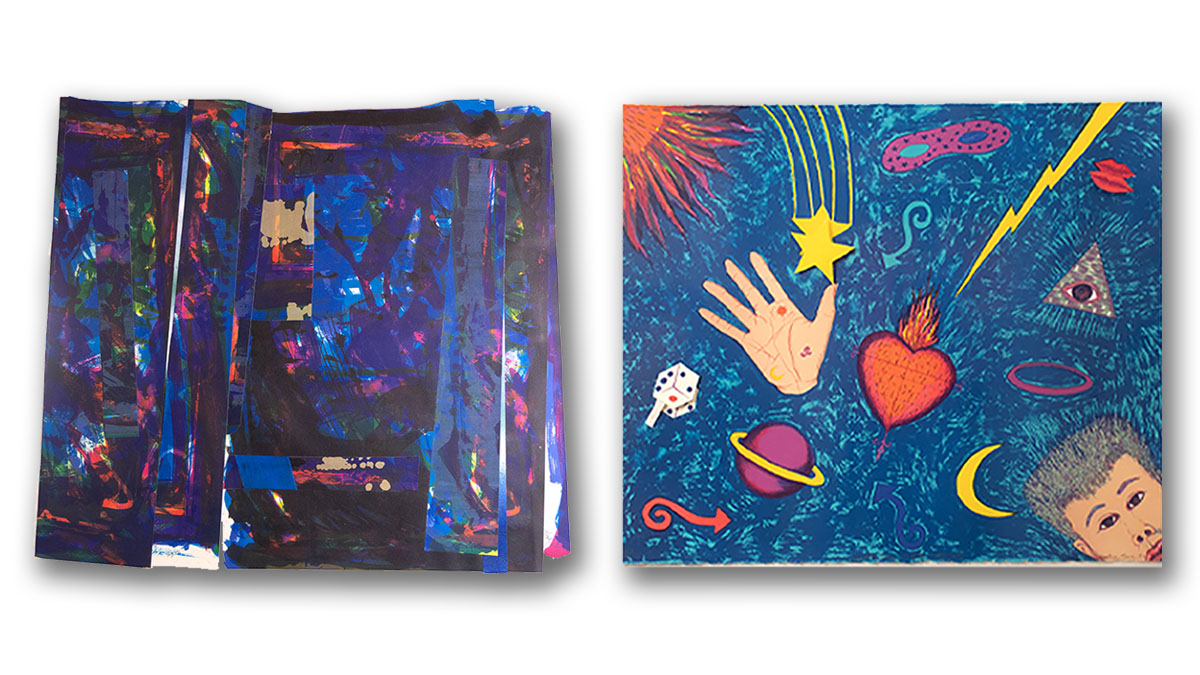
This View from the Vault honors the lives and legacies of two trailblazing Black women artists, Mary Lovelace O’Neal (1942–2026) and Betye Saar (1926–2026). The works featured here—Prophet with No Tongue and Mystic Sky with Self-Portrait—will be on view in two fall 2026 Museums exhibitions: Assembled: Collage, Assemblage, and Mixed Media and The People Could Fly: Black Religion, Spirituality, and Liberation, respectively.
Both works entered the University’s collections more than two decades ago as gifts from the Brandywine Workshop. Over the years, they have become familiar and beloved to students, faculty, staff, and visitors. Now, as they take on new life within these exhibitions, they also serve as messengers of the artists’ enduring creative legacies—reminding us of the ways art can carry memory, history, identity, and possibility across generations.
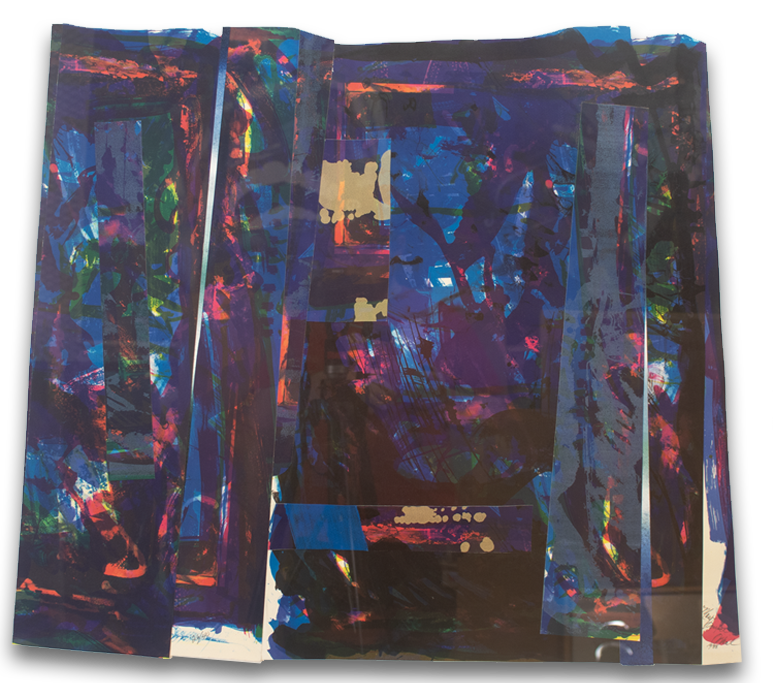
Mary Lovelace O’Neal, Prophet with No Tongue, 1988, offset lithograph and collage.
Museums Collections, Gift of Brandywine Workshop, Philadelphia, PA.
Courtesy of Brandywine Workshop Archives, Philadelphia, PA.
Mary Lovelace O’Neal had a distinguished six-decade career, with her work exhibited and collected widely. Although she resisted efforts to categorize her practice or career, she became particularly known for her abstract work and her sustained engagement with Abstract Expressionism and Minimalism. Her lithograph Prophet with No Tongue, which she cut apart and reassembled as a collage, was selected for Assembled: Collage, Assemblage, and Mixed Media in Mechanical Hall Gallery.
The work’s distinctive black background reflects O’Neal’s longstanding engagement with black as both a color and a complex field of meaning, association, history, and aesthetic possibility. Beginning in the 1960s, she experimented with lampblack in her paintings, and enigmatic black grounds became a hallmark of much of her work. She spoke of wanting to create the blackest paintings possible while emphasizing Africa’s significance to the history of abstraction.
In a 2021 interview, O’Neal reflected on the resistance she encountered when making that connection explicit: “They refused to deal with the whole question of abstraction that comes out of Africa, and I made the argument with them that this is exactly what I was making, what it was about for me.” Her work, she explained, addressed both “the social question of Blackness” and “the theoretical question about Black painting.”
O’Neal’s artistic practice was shaped alongside a commitment to teaching and mentorship. She earned her BFA from Howard University, where she studied with artists including David C. Driskell and Loïs Mailou Jones, before earning an MFA from Columbia University. In the late 1970s, she joined the Department of Art Practice at the University of California, Berkeley, where she was tenured in 1985 and later served as department chair. Across her career, her influence extended beyond her own work to the generations of artists she taught and encouraged.
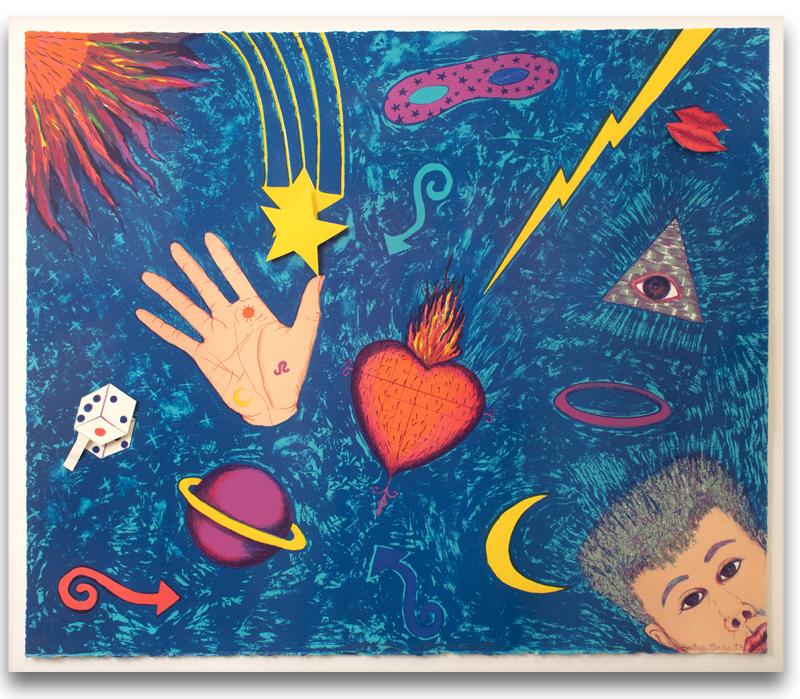
Betye Saar, Mystic Sky with Self-Portrait, 1989, offset lithograph and collage.
Museums Collections, Gift of Brandywine Workshop, Philadelphia, PA .
Courtesy of Brandywine Workshop Archives, Philadelphia, PA.
Betye Saar’s Mystic Sky with Self-Portrait was selected for The People Could Fly: Black Religion, Spirituality, and Liberation, curated by Qiaira Riley, Graduate Research Assistant for Museums. Saar initially studied design at Pasadena City College and the University of California, Los Angeles, and went on to build a decades-long career rooted largely in Los Angeles.
The lithograph in the Museums collections brings together many of the elements that have defined Saar’s practice: printmaking, collage, found imagery, symbolism, spirituality, and an interest in the unseen forces that shape human experience. Saar worked extensively as a printmaker and as a collage and assemblage artist, often incorporating found objects and images into her work. She was deeply interested in mysticism, the occult, and symbols associated with a wide range of spiritual traditions.
In Mystic Sky with Self-Portrait, symbols drawn from palmistry, tarot, and Hoodoo appear alongside Saar’s self-portrait in the lower right. At the center of the composition is a red heart-shaped vèvè, a ritual symbol associated with Haitian Vodou and African American Hoodoo. These layered references invite viewers to consider the ways spiritual knowledge, cultural memory, and personal identity can coexist within a single work of art.
Together, O’Neal and Saar represent generations of artists who challenged the boundaries of the art world while creating new possibilities for those who followed. Their work insists on the significance of Black artistic traditions, Black women’s creative voices, and the many ways artists can claim, transform, and reinterpret histories that have too often been overlooked.
That legacy is also reflected in the growing recognition and preservation of their papers and archives. In 2018, the Getty Research Institute acquired Betye Saar’s archives as part of the establishment of its African American Art History Initiative. Reflecting on that moment, Saar observed that the art world had taken a long time to recognize African American artists and added, “it still has a long way to go.”
The works of Mary Lovelace O’Neal and Betye Saar remind us that collections are never static. They continue to speak, to challenge, and to reveal new connections as each generation encounters them. This fall, Prophet with No Tongue and Mystic Sky with Self-Portrait offer two such encounters—opening pathways into the artists’ lives and practices while inviting us to consider the histories, spiritual traditions, and creative possibilities they carried forward.
Their work remains with us: in the collection, in the exhibitions, and in the artists who continue to build upon the paths they helped make visible.
“A View from the Vault” showcases some of the unique, notable or rare items that are a part of the Special Collections and Museums holdings at the University of Delaware. Each month, we highlight a different work and share interesting facts or intriguing histories about it. If you are interested in seeing any of the materials featured in person or want to learn more about any work showcased in the series, please contact Special Collections and Museums at AskSpec or AskMuseums.