
The Legacy of Friends
After nearly seven decades, the Friends of the Library makes a final gift
Every day, students, scholars and researchers on the University of Delaware’s campus — and around the world — can access rare British manuscripts and art, a Shakespeare folio and some two million other unique resources from UD’s Library, Museums and Press’ Special Collections, which is partly supported by the annual contributions of Friends of the Library.
For nearly 70 years, the philanthropic group has contributed more than $2.5 million in support of the UD’s Library, Museums and Press. Their generosity has helped transform the scope and impact of the University’s scholarly assets.
Now, after careful consideration and reflection, the Friends dissolved as an organization at the end of the 2025-2026 fiscal year, said President Jim Dalle Pazze at their farewell dinner this past April celebrating the group’s generosity over the years.
“It’s bittersweet,” said Dalle Pazze. “But we have done what we set out to do,” he said. “Friends groups have been dissolving nationally because donors are choosing to give directly to their library of choice.”
UD students, faculty and the broader community are encouraged to make donations directly to the library.

Alison Parker, UD’s Richards Professor of American History, holding and discussing an Alice Dunbar Nelson article owned by Special Collections.
As part of its final chapter, the Friends will give the library a $2.25 million gift, continuing their support of the library’s ongoing work and reinforcing their legacy. The gift will be used for the remaining costs of the Special Collections renovation project, along with two additional endowments that will provide ongoing support for library programming and Special Collections acquisitions, said Dalle Pazze.
A private Special Collections ribbon-cutting ceremony will be held Thursday as the official opening of the new Special Collections space.
Dalle Pazze said the Special Collections renovation ensures that future generations of students will experience the same wonder and discovery that has inspired members of the Friends for nearly 70 years.
Beyond Special Collections, the Friends’ generosity also created meaningful opportunities throughout the library. These include digitization efforts and investments in student initiatives like the Seth Trotter Book Collecting Contest and the Seth Trotter Special Collections Research Awards, said Beth Brand, UD’s vice president of development and alumni relations.
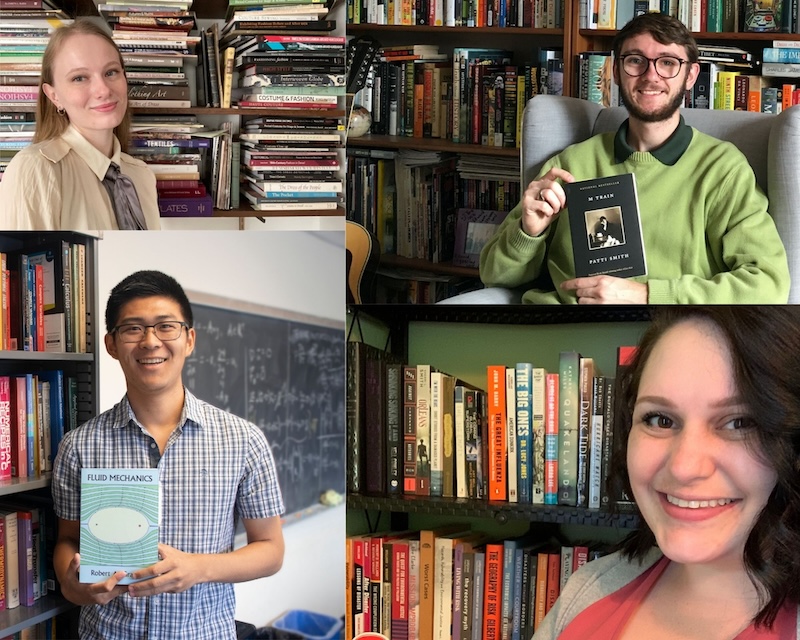
UD alumni and previous winners of the Seth Trotter Book Collecting Contest: (top left to right) Margaret O’Neil (2021) and Edward Benner (2020); (bottom left to right) Nakao Joseph (2019) and Logan Gerber-Chavez (2021).
“The Friends’ philanthropy has been truly transformational for the University and reflects a longstanding commitment to advancing knowledge, access and discovery,” Brand said. “We are deeply grateful for all they have contributed and hope they remain closely connected to the UD community they have helped build.”
Their commitment to the Library, the University and the students is what stood out most to Tywanda Cuffy, the Library’s director of external relations, communications and development initiatives, as she worked closely with the group since 2018 to plan Friends-sponsored events and initiatives.

The late John Hurt, a professor emeritus of history and former chair of the history department at the University of Delaware who specialized in 17th- and 18th-century European history. At the 2015 Friends Faculty Lecture, Hurt presented “Odyssey of Bombardier,” a book he co-authored.
The Friends’ history began in late 1957 with the formation of the University of Delaware Library Associates. Several months later, the group had 234 members and an endowment fund of $50,000. The certificate of incorporation stated that the organization’s purpose was to promote and foster the development and expansion of the sections of UD’s Library that were devoted to the field of liberal arts.
Later, the purpose expanded to assist in making the University a center of humanistic learning through the most effective and imaginative use of its library facilities. The UDLA later changed its name to the Friends of the Library.
One of the Friends’ first acquisitions was the microfilm edition of The New York Times from 1851 until 1912.
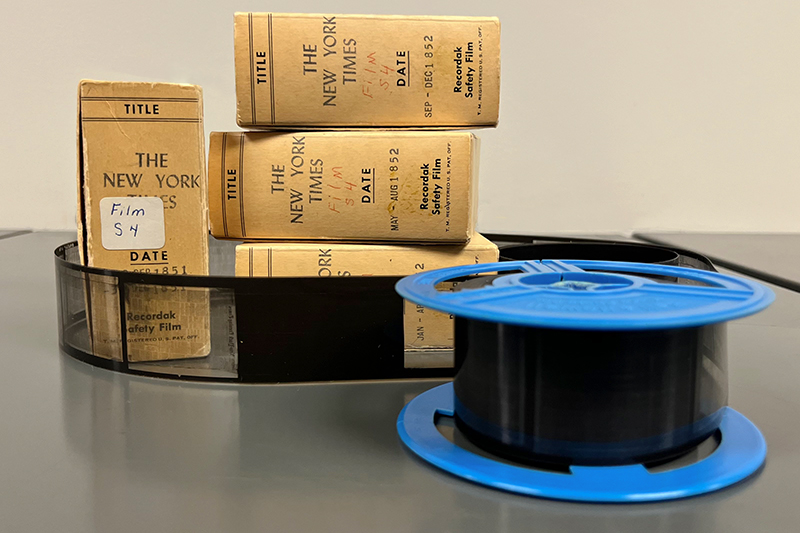
Special Collection microfilms of The New York Times dated between 1851-1852.
“The legacy of the Friends will continue,” said Trevor A. Dawes, the vice provost for Libraries and Museums and May Morris University Librarian at the University of Delaware Library, Museums and Press. “It is easy for everyone to remember the level of financial support that the Friends have given over the years, and we are certainly grateful for it, but the camaraderie of the Friends is just as memorable.”
Among many of the notable acquisitions, in 2025, funding from the Friends was used to acquire a rare first edition copy of Jane Austen’s Pride and Prejudice.
“Published in 1813 in three volumes, first editions of the book continue to be highly prized, as only approximately 1500 copies of the first printing were issued,” said Hillary Kativa, head of special collections. “Like many readers, Austen’s classic tale of the Bennet sisters and their romantic entanglements is one of my favorite books so this acquisition was a particularly special one. Notably, 2025 also marked the 250th anniversary of Jane Austen’s birth, making this an especially timely acquisition for Special Collections.”
For decades, the Friends held annual lectures and annual dinners for UD faculty to highlight their research and publications. These were also special occasions for them to invite authors, including Michael Dirda, Elyse Graham, Margaret MacMillan, Walter Isaacson, Erik Larson and other best-selling writers to Delaware to speak.
“The highlight of the many activities that the Friends sponsored over the years has been our annual dinners each spring,” said Ted Killheffer, a 20-year member of the friends who also joined their board of directors and served as a vice president, president and as a member of the executive committee. “Our purpose was to publicize the work of the Friends and the Morris Library, to attract new members and to provide an interesting evening for our members and colleagues at the University. It was especially gratifying to hear Erik Larson talk about his use of materials in our Special Collections in the research for his book on the rise of Nazi Germany.”
L. Rebecca Johnson Melvin, a retired manuscripts librarian and curator of the Joseph R. Biden, Jr., senatorial papers, became a member of the group shortly after being hired at UD. She, too, spoke highly of the group’s unforgettable camaraderie, generosity and connection with the UD community.
She said the library is world-renowned because of the acquisitions made possible by the Friends.
“It’s incredible, the collections that were built over the years,” Melvin said. “Early in my career, the Friends celebrated their 2 millionth acquisition; they also supported the acquisition of Shakespeare’s second folio.”
The core of most great Special Collections comes from alumni who are also collectors, said Timothy Murrary, retired head of special collections at UD and a board member of the Friends.
“In the beginning, we didn’t have that, so that’s why Friends are important to us,” he said. “Their funding, which historically included an annual $100,000 gift, has been integral to building the library as a major research library.”
Cuffy shared gratitude that the Library has for the Friends.
“I want them to know how incredibly grateful we are for the years of dedication, support, wisdom and love they have poured into this institution,” Cuffy said. “While the Friends may no longer exist as a formal entity, the spirit of this group and the relationships they built with the Library will absolutely continue; their heart for this place will always remain an integral part of the Library’s story.”